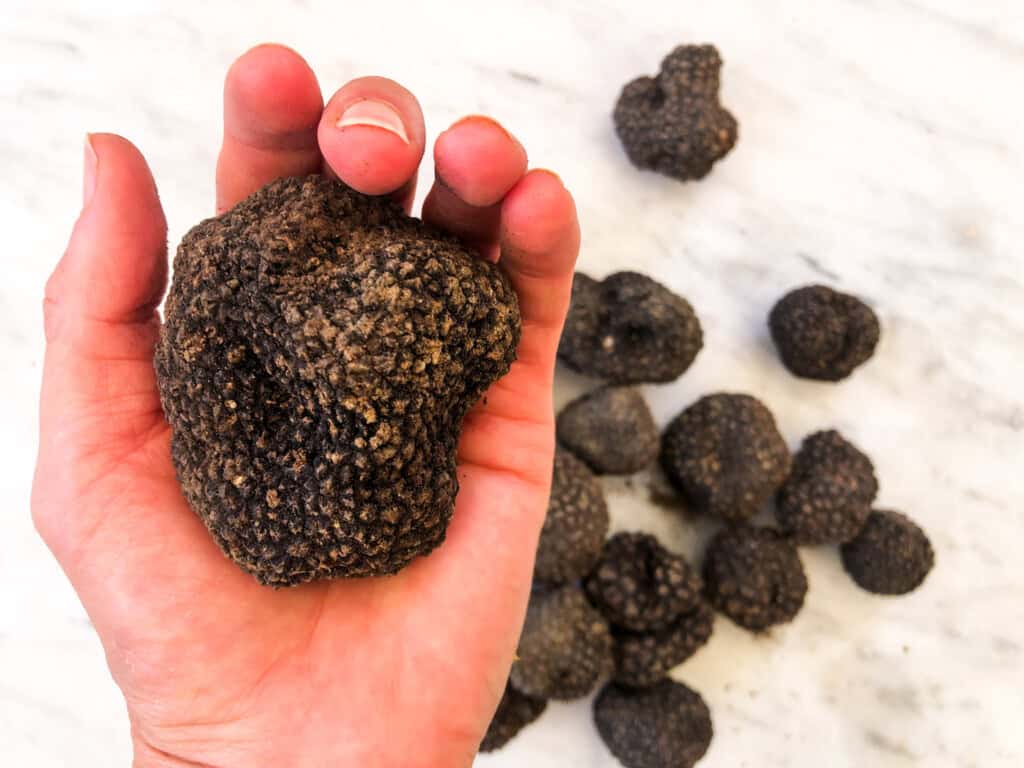
It looks simple from the outside: a person, a dog and a small shovel. In reality, hunting truffles in Italy is a regulated activity, and nobody is allowed to dig a single tartufo without a license called the tesserino.
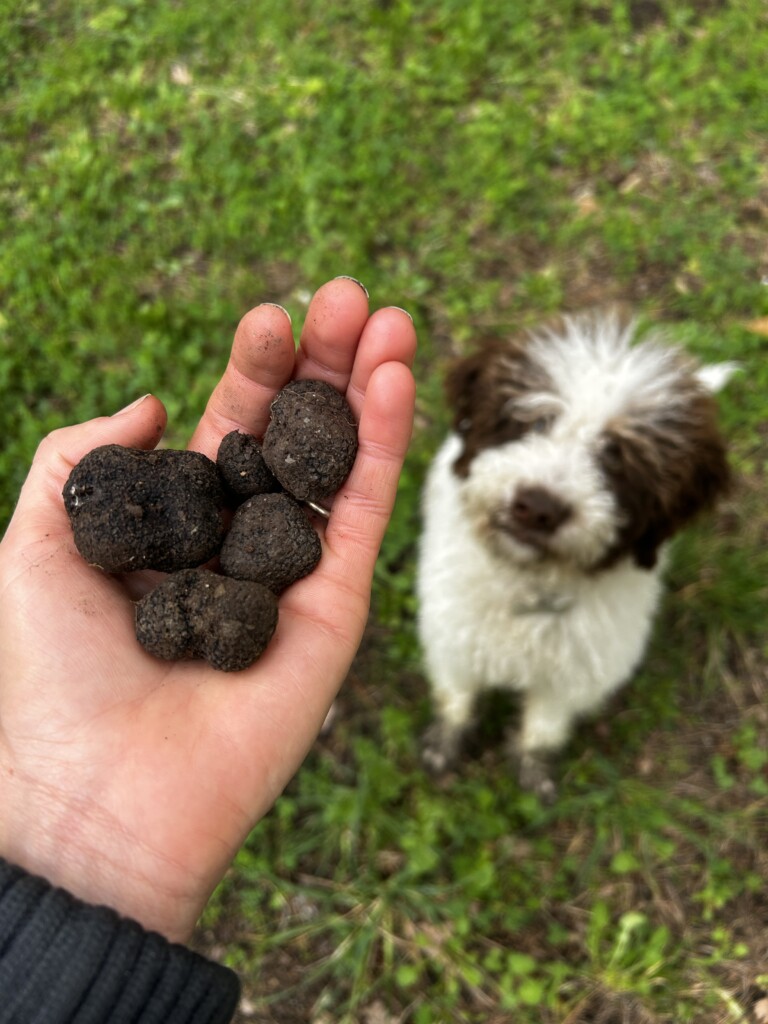
I’m Louisa, and I have lived in Tuscany with my family since 2012. Truffle season is one of my favorite times of year here. Our family has a Lagotto Romagnolo named Jesse, a specific dog bred to hunt truffles. Although he is first and foremost our pet, he is also a hard worker, digging up plenty of truffles for us on our property.
In this guide I explain exactly how to get a truffle hunting license in Italy based on my own experience having completed the exam in 2026: who can apply, the training course, the exam, the costs and the rules you have to follow once you have your tesserino. I use Tuscany as an example, although most regions are similar or have similar systems for obtaining the license.
Jump to Section
Quick Guide: How to Get a Truffle Hunting License in Tuscany
| Step | What You Do | Where | Cost |
|---|---|---|---|
| 1. Training course | Attend the 30-hour percorso formativo (online) | EDART regional portal | Free |
| 2. Exam application | Apply for the exam once the course is done | EDART portal (SPID, CIE or CNS login) | €16 marca da bollo (a paid stamp) |
| 3. Written exam | 30 multiple-choice questions in 30 minutes; 26 correct answers to pass | Regional exam session | Included |
| 4. Request the tesserino | Apply within 365 days of passing | Your comune (town hall) of residence | First annual payment |
| 5. Annual payment | Pay before you hunt each calendar year | IRIS online/PagoPA or bank transfer | €92.96 per year |
| 6. Renewal | 8-hour refresher course, no new exam (every 10 years) | EDART portal | Free course |
What Is a Truffle Hunting License in Italy?

The truffle hunting license in Italy is officially called the tesserino di idoneità (or tesserino di abilitazione in Tuscany) alla ricerca e raccolta dei tartufi. It’s a photo ID card that proves you passed an exam and are allowed to search for and dig up truffles. If you are new to the topic, start with my guide to truffles in Italy, which covers the different varieties and where they grow.
The national framework is Law 752 of December 16, 1985. It requires every truffle hunter to pass an exam, sets the minimum age at 14 and makes the license valid across the whole country. It then leaves the details (exams, fees, seasons, hours and fines) to each of Italy’s regions, which is why the process in Tuscany looks different from the one in Piedmont or Lazio.
Italy takes this seriously for good reason. Truffles are among the foods Italy is famous for, and in December 2021 “Truffle hunting and extraction in Italy: traditional knowledge and practices” was added to UNESCO’s list of Intangible Cultural Heritage. The license system exists to protect the tartufaie (truffle grounds) from careless digging, so they keep producing year after year.
Who Can Get a Truffle Hunting License?
Minimum Age: 14 under national law; 16 in Tuscany under Regional Law 36/2023
Who Issues It: In Tuscany, the comune or town where you are a resident
Valid In: All of Italy
Language: Italian (the EDART portal, forms and published exam questions are all in Italian)
I highly recommend you have a good knowledge of the Italian language before committing to the test. There is a lot of technical vocabulary and general information about forestry, mushrooms, food safety and Italian law.
Because the tesserino is requested from your comune of residence, the system is built for people who live in Italy. If you live in Italy but outside Tuscany, the region advises asking your own comune how the license is issued where you live, since your home region’s rules apply.
Minors can take the exam in Tuscany, but the application needs a signed delegation form and a copy of a parent’s or guardian’s ID, and a parent has to come along on exam day.
Good To Know: National law exempts people hunting on land they own. Tuscany is stricter for officially recognized truffle grounds: owners of a tartufaia coltivata (cultivated truffle ground) or tartufaia naturale controllata (managed natural truffle ground) still need to pass the exam and hold a tesserino to hunt there.
How to Get a Truffle Hunting License in Tuscany: Step by Step
Tuscany’s Regional Law 36 of August 2, 2023 replaced the old 1995 truffle law, and its implementing regulation came into force in January 2025. The biggest change is that you can no longer just book the exam. You now have to complete a training course first.
Step 1: Take the 30-Hour Training Course (Percorso Formativo)
The course lasts at least 30 hours and is run by the mycological inspectorates of the local health authority (USL), which bring in experienced truffle hunters and the recognized truffle hunters’ associations. Lessons are held online in the evenings, and the course is free.
You register on the region’s EDART portal, logging in with SPID, CIE (electronic ID card) or CNS.
Step 2: Apply for the Exam
Only people who have completed the course can apply for the exam, again through the EDART portal. You attach a form showing you paid a €16 marca da bollo (revenue stamp).
Step 3: Pass the Written Exam (Esame di Idoneità)
The exam is written only. You get 30 multiple-choice questions and 30 minutes, and you need at least 26 correct answers to pass. You are contacted by email and must bring a valid ID.
By law, the exam covers six subjects:
Truffle ecology (ecologia dei tartufi)
Principles of truffle cultivation (tartuficoltura)
Truffle law: the regional law, its regulation and related rules
Food law: traceability and food hygiene basics
Truffle dog welfare: care and protection of the cane da tartufo
Mycology, botany and forestry
Good To Know: Tuscany publishes the full list of exam questions and answers (Decree 12918 of June 13, 2025) on its website, along with technical sheets on each truffle species. Studying that list is the single best way to prepare in my experience.
Step 4: Request Your Tesserino From Your Comune
Passing the exam gives you an attestato di idoneità, not the license itself. You then apply to your comune of residence with proof of payment and the details of your certificate. You have 365 days from the exam to do this; after that, you have to pass the exam again.
Step 5: Pay the Annual Fee Every Year
Tuscan residents pay €92.96 a year to the Region of Tuscany. The payment covers the calendar year (January to December) and isn’t owed in a year you don’t hunt. You can pay by bank transfer or through the region’s IRIS platform, which runs on PagoPA.
Step 6: Renew After 10 Years
The Tuscan tesserino is valid for 10 years from the date it’s issued. To renew it, you attend an 8-hour refresher course in the year before it expires, with no new exam. Anyone who already held a license under the old law also needs that refresher course when it runs out.
How Truffle Licenses Work in Other Italian Regions
Every region follows the same 1985 national law, but the details vary. Here’s how a few of them compare, based on each region’s official information.
Piedmont
Exam: Before a commission, focused on national and regional truffle rules
Validity: 10 years, renewable without a new exam
Annual Fee: A regional concession tax, paid each year
Piedmont manages licenses through its online Portale Tartufi. It’s the home of the Alba white truffle, which I cover in my guide to traditional food in Piedmont.
Lazio
Exam Application: €16 revenue stamp; 9 or more mistakes means you fail
Annual Fee: €50.62, due by January 31 each year, plus a €16 stamp on the tesserino
Veneto
Applications: Online since January 2025 through the regional platform
Validity: 10 years, renewable without a new exam
Annual Fee: Due by January 31, or within three months of the first issue
Umbria, Le Marche, Abruzzo and Molise
These are some of Italy’s biggest truffle regions too, and each has its own law, exam and calendar. If you live there, check with your region before you apply. For what to eat once truffle season starts, see my guides to Umbrian food, food in Le Marche, Abruzzo and Molise.
Truffle Hunting Rules in Tuscany Once You Have Your License
Getting the tesserino is only half of it. Tuscany also sets strict rules on when, where and how you hunt, and they are exactly what the exam tests you on.
Truffle Seasons in Tuscany (Calendario di Raccolta)
| Truffle | Italian Name | Latin Name | Season in Tuscany |
|---|---|---|---|
| White truffle | Tartufo bianco pregiato | Tuber magnatum | October 1 – January 15 |
| Black winter truffle | Tartufo nero pregiato | Tuber melanosporum | November 15 – March 15 |
| Burgundy truffle | Tartufo uncinato | Tuber aestivum f. uncinatum | October 1 – January 15 |
| Summer truffle | Scorzone | Tuber aestivum | June 1 – August 31 and October 1 – November 30 |
| Bianchetto | Tartufo bianchetto or marzuolo | Tuber borchii | January 15 – April 15 |
| Winter black truffle | Tartufo nero d’inverno | Tuber brumale | January 15 – April 15 |
| Musky black truffle | Tartufo nero moscato | Tuber brumale f. moschatum | January 15 – April 15 |
| Smooth black truffle | Tartufo nero liscio | Tuber macrosporum | October 1 – December 31 |
| Common black truffle | Tartufo nero ordinario | Tuber mesentericum | October 1 – December 31 |
All truffle hunting is banned throughout May and September, a break called the fermo ecologico. This is the same seasonal logic behind why Italians eat seasonally, and it’s why fresh white truffle show up on menus in my lists of foods to eat in Italy in October and November.
Hunting Hours
Night hunting is illegal. The law sets allowed hours for each month in solar time (adjusted during daylight saving time). In peak white truffle season, for example, hunting is allowed from 5:30 am to 6:30 pm in October, 6:30 am to 5:30 pm in November and 7:00 am to 5:30 pm in December.
Dogs and Tools
Dogs: A dog is required, and you can hunt with a maximum of two, including one in training
Tool: A vanghetto or vanghella (small spade) with a blade no bigger than 5 x 5 cm
Digging: Only at the exact spot where the dog started digging
Holes: Must be refilled right away with the same soil
Banned: Hoeing or raking the ground, and collecting unripe truffles
The classic Italian truffle dog is the Lagotto Romagnolo, a breed tied to the Romagna area that I write about in my guide to Emilia-Romagna food. Tuscan truffle hunters’ associations can also set up official dog training areas, where you can train dogs up to two years old but can’t take any truffles home.
Where You Can and Can’t Hunt
Truffle hunting is free (libera) in woods, uncultivated land, along the banks of public waterways and in pastures without livestock. It is not allowed:
Reserved Truffle Grounds: Signs reading “Cerca e Raccolta di tartufi riservata”
Dog Training Areas: Signs reading “Area addestramento cani da tartufo”
Private Gardens: Including land right next to homes, unless you own it
Plantations: Poplar groves, hazelnut orchards and active timber plantations
Reforested Areas: For 15 years after replanting
Wildlife Protection Zones: Throughout June
Parks and nature reserves set their own truffle rules, so check before you go.
Fines for Hunting Without a License
In Tuscany, hunting truffles without a tesserino, without paying the annual fee, out of season, at night, without a dog, without the proper tool or without refilling your holes can mean a fine of €500 to €5,000. Several of these violations also mean a one-year suspension of your license, and any truffles you found are confiscated. Fines for hunting without a license are doubled for repeat offenders.
Can Tourists Go Truffle Hunting in Italy Without a License?
Since the license runs through your Italian comune of residence, getting one on vacation isn’t realistic. The way most visitors do it is by joining a hunt led by a licensed tartufaio and their dog, which is one of the experiences on my Italy foodie bucket list.
In Tuscany, Regional Law 36/2023 officially recognizes seven truffle areas: the white truffle zones of the Casentino, the San Miniato hills, the Crete Senesi, the Mugello, the Val Tiberina and the Lucca area, plus the marzuolo zone along the Maremma coast near Grosseto. The Crete Senesi are an easy add-on to a trip to Siena (see my list of foods to try in Siena), and they’re close to the places in my guide on what to eat in southern Tuscany.
If you’d rather eat truffles than dig for them, plan around a truffle fair. San Miniato holds its national white truffle market over weekends in November, and smaller sagre pop up all over the region in the fall. Order tagliatelle al tartufo (here is my tagliatelle recipe if you want to make it at home), eggs with shaved truffle or pici with truffle, and bring home a jar of truffle products from my list of Tuscan food souvenirs.
Frequently Asked Questions
How much does a truffle hunting license cost in Italy?
It depends on the region. In Tuscany the training course is free, the exam application needs a €16 revenue stamp and the annual fee is €92.96 for each year you hunt. In Lazio the annual fee is €50.62, plus €16 stamps for the exam application and the license (in 2026)
How long is an Italian truffle hunting license valid?
In Tuscany, Piedmont and Veneto, the tesserino is valid for 10 years. You still have to pay the regional fee every year you hunt. In Tuscany, renewing it means taking an 8-hour refresher course, while Piedmont and Veneto renew without a new exam.
Can I use my truffle license in a different Italian region?
Yes. Under national law, the tesserino is valid throughout Italy. Tuscany doesn’t charge its annual fee to licensed hunters from other regions as long as they’re up to date with their home region, but you still have to follow the local calendar, hours and rules wherever you hunt.
Do you need a license to hunt truffles on your own land in Italy?
National law exempts people hunting on land they own. In Tuscany, owners of officially recognized cultivated or managed truffle grounds must still pass the exam and hold a license to hunt there, so check your region’s rules before you start digging.
Can you sell truffles you find with a hunting license?
The Tuscan truffle law covers hunting and cultivation, not sales.
Final Thoughts
Getting a truffle hunting license in Italy takes some commitment, especially in Tuscany, where you now need a 30-hour course, a written exam and an annual payment before you can take a dog into the woods. The rules protect a tradition that is now recognized by UNESCO, and they’re why there are still truffles to find every fall.
If you live in Tuscany, start by checking the region’s official truffle page and the EDART portal for the next course dates. Be sure you have a pretty good understanding of the Italian language. If you’re visiting, book a hunt with a licensed tartufaio and enjoy the truffles at the table.
More on Truffles and Fall in Italy: Fall Foods to Try in Italy | Italian Recipes for Fall | Produce to Try in October in Italy