Booking a cooking retreat in Italy is one of the best ways to understand Italian food, but not every class, culinary vacation or cooking holiday delivers what the brochure promises. Let’s take a closer look at how to choose a cooking retreat in Italy.
Ciao, I’m Louisa and I first came to Italy at 19 to work on Italian farms and never left. Over that time I have taken classes myself, sent friends and readers to teachers I trust, and heard plenty of honest feedback about which cooking experiences in Italy are worth the money and which aren’t. I even teach my own classes and retreats now!
Today I am sharing the 10 questions I would ask before choosing a cooking retreat in Italy, whether it’s a one-day pasta class or a week-long culinary vacation in the countryside. Start with the Quick Guide if you are comparing options right now, then read on for what each question really tells you.
Cooking Retreats in Detail: Is a Cooking Retreat in Tuscany Worth It? An Honest Look | How to Choose a Cooking Retreat in Italy: 10 Questions to Ask | Cooking Retreat vs. Cooking Class vs. Food Tour in Italy: Which Is Right for You? | What to Eat in Southern Tuscany – According To A Local | 6 Cooking Classes In Tuscany For Your Next Visit
Jump to Section
Quick Guide: 10 Questions to Ask Before Booking a Cooking Retreat in Italy
| Question to Ask | Why It Matters | Good Sign | Red Flag |
|---|---|---|---|
| 1. Is it hands-on or a demonstration? | You only learn by doing | Everyone gets a chance to participate | “Watch the chef” format |
| 2. Which region’s food will I cook? | Italian food changes drastically from region to region | Dishes tied to the place you are staying | Generic “Italian” menu |
| 3. Who is teaching? | Expertise matters | Experience with Italian food and local roots | No teacher named anywhere |
| 4. How big is the group? | Affects attention and pace | Anywhere from 12 and below | No group limit listed |
| 5. What is included in the price? | Avoids surprise costs | Clear list of meals, wine, lodging, transfers | Vague “experiences included” |
| 6. Where will I stay? | Shapes the whole trip | Working farm, villa or family home | Lodging far from the kitchen |
| 7. What is in season? | Seasonal food is the point | Menu changes with the month | Same menu year round |
| 8. Can they handle my diet? | Safety and enjoyment | Asks for details before you arrive | “We’ll figure it out” |
| 9. What else is on the schedule? | Balance and value | Market, winery or producer visits plus free time | Every hour booked or no unique experience |
| 10. Can I cook it at home? | The real souvenir | Recipes sent after the class | Nothing to take home |
Cooking Retreat vs Cooking Class vs Culinary Vacation
These terms get mixed up a lot, so it helps to know what you are actually comparing.
Cooking Class: A single session, usually 3 to 6 hours, that ends with a meal of the dishes you made as a group.
Cooking Retreat: Several days built around cooking, often with lodging, daily lessons and/or foodie experiences and time to slow down in between.
Culinary Vacation (or Cooking Holiday): Very similar to a cooking retreat but I would consider it a wider food trip that may include a few classes but is more based on food experiences such as wine tastings, market visits and producer tours.
If you only have one free day near Florence, a half-day class is the right fit. If you want to unplug in the countryside and actually learn a cuisine, a multi-day retreat is worth looking at. I cover some of my favorite single classes in my guide to cooking classes in Tuscany.
10 Questions to Ask Before You Book

1. Is the Class Hands-On Cooking Class or a Demonstration?
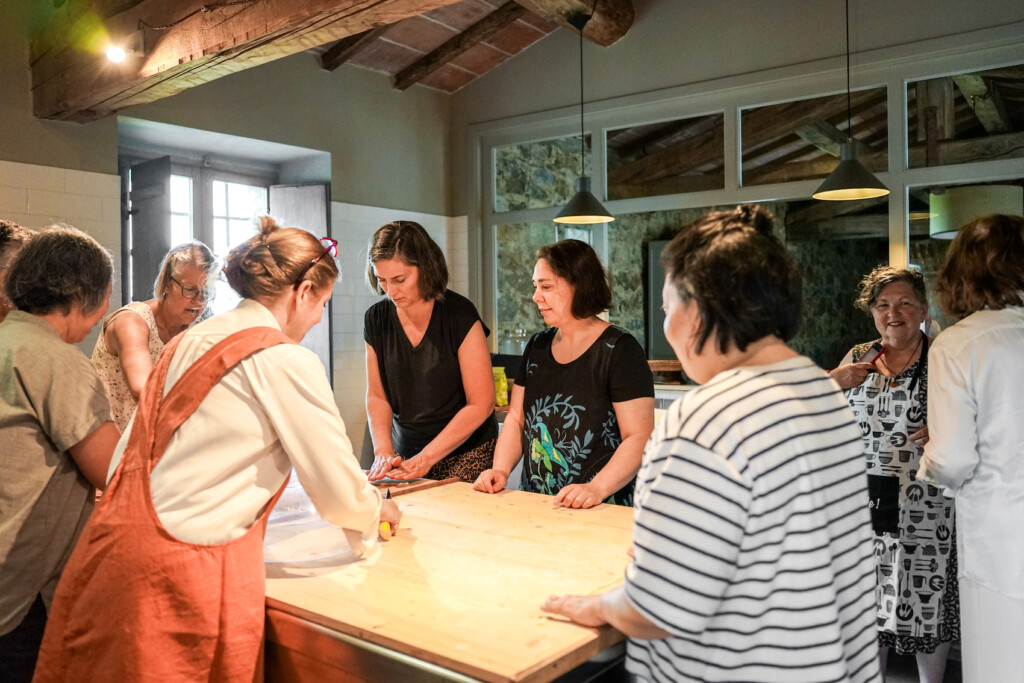
This is the first thing I ask and check when helping plan a class for a client or friend. In a hands-on cooking class you knead, roll and shape your own dough. In a demonstration you sit and watch someone else cook, which can be fun but isn’t the same thing.
Ask: “How much of the time will I be cooking myself?”
Look For: Your own pasta board, and a clear split between cooking time and eating time.
Good To Know: A typical well-run class spends a couple of hours cooking and then sits down together to eat a full Italian meal, often a three course meal with a mix of antipasto, primo, secondo and dolce.
2. Which Region’s Food Will I Be Cooking?
There is no single “Italian food.” Each of Italy’s 20 regions has its own pastas, breads and sauces, and a good cooking retreat teaches the food of the place you are actually in. A class in Tuscany that teaches you to make pizza is a sign the menu was built for tourists rather than for the region.
Here is what I would expect to make in some of the most popular regions for a cooking vacation in Italy:
Tuscany: Hand-rolled pici, ribollita, simple meat ragù and classic Tuscan dishes built on bread, beans and olive oil.
Emilia-Romagna: Egg pasta rolled with a rolling pin, tagliatelle and filled pastas like tortellini from Bologna and the rest of the region.
Puglia: Orecchiette shaped by hand from durum wheat semolina and water, plus the vegetable-heavy cooking of Puglia.
Sicily: Sweets, citrus, seafood and Sicilian classics like arancini and caponata.
Liguria: Pesto made in a mortar and authentic Ligurian focaccia.
If you are still deciding where to go, my roundup of famous Italian pasta dishes by region is a good place to start.
3. Who Is Teaching the Class?
The teacher makes or breaks a cooking retreat. Some classes are taught by a home cook or nonna who learned these recipes in her own family kitchen. Others are run by trained chefs who explain the why behind every step. Both can be wonderful, as long as you know which one you are booking.
Ask: “Who will teach the class, and do they cook this food at home or in a restaurant?”
Look For: A person with experience and expertise.
Red Flag: No teacher listed, or a different instructor every week through a booking platform.
Also ask what language the class is taught in. Many teachers in tourist areas speak good English, but some of the best home cooks don’t, and the class may run through a translator.
4. How Many People Are in Each Class?
Group size changes everything. Most of the small group cooking classes in Italy I recommend cap their groups at 12 people, which is enough for a lively table but still lets the teacher check everyone’s dough.
Small Group cooking class (up to 12): Best for learning technique and asking questions.
Private Class: Ideal for families, couples or friends who want the menu tailored to them.
Large Group (15+): Fun for celebrations, but expect less one-on-one teaching.
5. What Exactly Is Included in the Price?
Prices for an Italian cooking retreat vary widely, so compare what you are getting, not just the total. Two retreats with the same price can be very different once you add up meals, wine and transport.
Ask About: Lodging, all meals or only the class meals, wine with lunch and dinner, airport or train station transfers, excursions and entrance fees.
Also Ask: What is the cancellation policy, and is a deposit refundable?
6. Where Will I Be Staying?
On a multi-day retreat, where you sleep shapes the whole trip. An agriturismo (a working farm that also hosts guests) puts you close to where the ingredients come from. A private villa gives you space and privacy. A castle or wine estate adds a bit of luxury, often with wine made on site.
Think about logistics too. Many of the best countryside retreats are a long way from a train station, so ask whether you need a rental car or whether transfers are included. If the lodging is in one town and the kitchen in another, find out how you get between them every day.
Good To Know: If you stay at a winery or a farm, ask whether you can join a tasting or a tour of the estate. In Southern Tuscany, many of the Montepulciano wineries are an easy add-on to a cooking stay.
7. What Time of Year Is the Retreat, and What Will Be in Season?
Italians cook with the seasons, and the best cooking retreats do too. A menu that is identical in May and November tells you the ingredients aren’t coming from nearby. I explain more about this in my guide to why Italians eat seasonally.
Spring: Fresh peas, fava beans, artichokes and wild greens.
Summer: Tomatoes, zucchini, eggplant, basil and stone fruit.
Fall: Grape harvest, porcini mushrooms, leafy greens, beans, chestnuts and new olive oil.
Winter: Hearty soups, black cabbage, citrus in the south, and truffles.
Fall is a wonderful time for a cooking vacation in Italy. The olive harvest runs anywhere from October to December depending on the region, and white truffle season starts in October. Late October through November is the best window if fresh truffles are on your wish list.
Good To Know: Many countryside cooking schools run seasonally, often from spring to late fall, so check the dates before you plan the rest of your trip around a class.
8. Can They Accommodate My Dietary Needs?
Italian cooking leans heavily on wheat, dairy and cured meats, so if you are celiac, vegan, vegetarian or have a food allergy, ask before you book, not when you arrive. Good teachers should be able to adapt the menu.
Ask: “Can you adapt the full menu, or just leave things out of my plate?”
Celiac Travelers: Ask how they prevent cross-contamination, since gluten is typically a large part of the Italian diet.
For more help, read my guides to eating with dietary restrictions in Italy, eating gluten-free in Italy and how to eat vegan in Italy.
9. What Else Is on the Schedule Besides Cooking?
The best Italian cooking retreats get you out of the kitchen too. A morning at the local market, a visit to a cheesemaker, an olive oil tasting or an evening at a village sagra (food festival) teaches you as much about Italian food culture as the class itself.
Look for a balance of cooking, outings and a free afternoon when you can simply sit in the garden with a glass of wine.
Market Visit: Shopping with your teacher is one of the best ways to learn how to shop at markets in Italy.
Food Festivals: Ask if a sagra is happening nearby during your stay.
10. Will I Be Able to Cook These Recipes at Home?
For me, this is the real test of a good cooking class in Italy. The point is to go home and make the dishes again for your family. Ask whether you will get the recipes in writing (in English) and whether the ingredients can be found outside Italy.
A good teacher will explain substitutions, like which flour to buy at home, and the simple habits that make the biggest difference, like cooking pasta the Italian way.
Good To Know: Some of the best edible souvenirs from a cooking retreat are the ones you used every day, like a bottle of new-season olive oil or a bag of local pasta. My guide to food souvenirs from Tuscany has ideas for what to bring back.
Frequently Asked Questions
Do I need cooking experience to join a cooking retreat in Italy?
No. Most cooking classes and retreats in Italy are designed for home cooks of every level, including complete beginners. If you are already confident in the kitchen, ask whether they offer an advanced or private class so you aren’t repeating basics.
Are cooking classes in Italy taught in English?
Many are, especially in popular areas like Tuscany, Florence and the Amalfi Coast. Some of the most traditional home cooks speak only Italian or a local dialect and teach with a translator, so always confirm the language when you book.
Is a cooking retreat in Italy a good idea for solo travelers?
Yes. Small-group cooking retreats are perfect for solo travelers, because you share every meal with the group and rarely eat by yourself. Ask whether there is a single supplement for lodging, since many retreats price rooms for two.
Can kids take a cooking class in Italy?
Many cooking schools welcome families, and pasta classes are usually a hit with children. Some teachers cater specifically to families and large groups, so ask for a minimum age and whether they offer private family classes.
How far in advance should I book a cooking retreat in Italy?
Book multi-day retreats as early as possible, since many accept only a handful of guests per session and the most popular dates fill months ahead. Single cooking classes can sometimes be booked a few weeks out, but spring and fall are busy in the countryside, so earlier is always safer.
Hungry for more? Best Cities in Italy for Food | Food Italy Is Famous For | Food Markets in Italy
Eating in Italy Basics: What Is a Coperto? | Tipping in Italy | What Time Do Italians Eat Dinner? | Coffee in Italy